
“Finally, brothers and sisters, whatever is true, whatever is noble, whatever is right, whatever is pure, whatever is lovely, whatever is admirable—if anything is excellent or praiseworthy—think about such things.”
Philippians 4:8
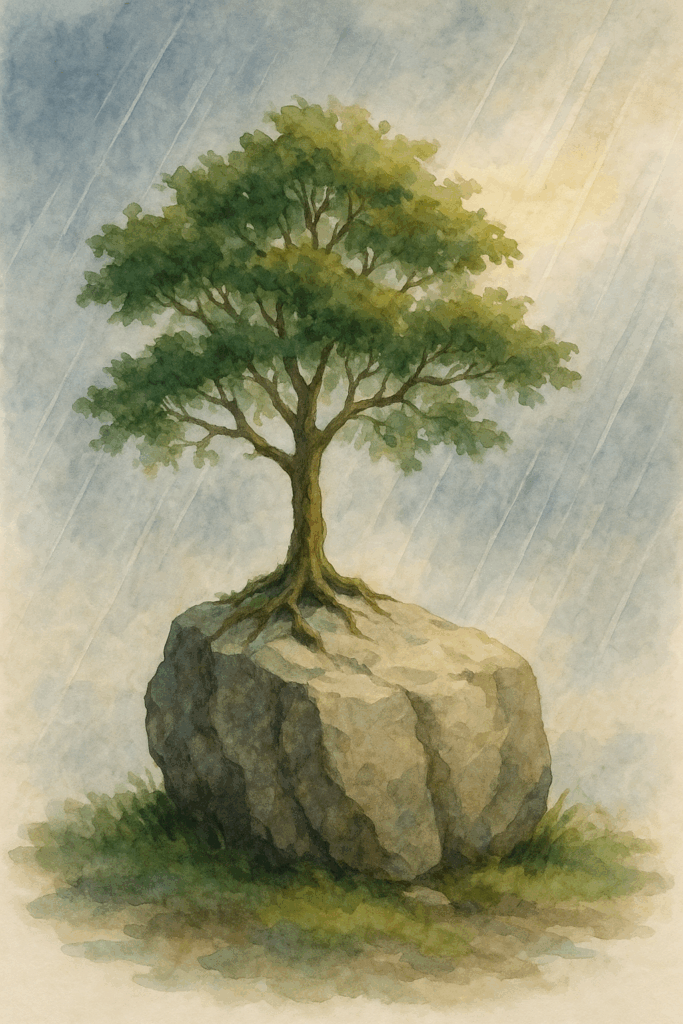
The Soil of Virtue
Virtue does not bloom overnight. It is not born from comfort or ease, but from the slow shaping of the soul in the hands of endurance. Like roots pressing through stone, the growth of virtue demands resistance. Patience takes form through delay, courage through fear, humility through humiliation.
In a world that rewards speed, self-interest, and noise, virtue can seem ancient—a relic of simpler times. Yet it is here, buried beneath the clamor, that true strength lives. Virtue is not performance; it is the steady, unseen decision to choose the good even when the world applauds the clever. The soil of virtue is often dark and hidden, but what it yields is light.
You will not always feel noble, pure, or steadfast. You will falter, doubt, and sometimes act against the very ideals you long to live by. But every return to virtue is an act of resurrection—a small rising of the spirit toward the light.
Building Stones of Character
Every virtue is a stone in the architecture of the soul. Some stones come easily—kindness, perhaps, or honesty. Others must be quarried through trial and fire: forgiveness, humility, perseverance. But as each is placed with intention, the foundation grows stronger.
Virtue is not moral perfection. It is the art of alignment—bringing what you value, believe, and do into harmony. Each time you choose honesty over convenience, compassion over judgment, or gentleness over pride, you build upon that inner temple.
When the noise of the world rises, pause and name a virtue you wish to strengthen. Hold it in your heart as a craftsman holds a tool. Ask God to refine it within you—not for appearance, but for purpose. For the highest virtue is not to be seen as good, but to become good quietly, persistently, and truthfully.
Carrying Virtue into Daily Life
Virtue becomes visible not in grand gestures but in the smallest acts of ordinary grace. The patience you show in traffic, the honesty in a simple conversation, the courage to apologize first—these are the living expressions of faith at work.
Carry your virtues like seeds in your pocket. Scatter them where frustration, envy, or despair might otherwise take root. Speak truth even when silence would be easier; offer gentleness when the world grows harsh. The harvest will not appear at once, but time will reveal its fruit.
The Apostle Paul did not call us to perfection but to pursuit—to think upon whatever is true, noble, and pure until our thoughts become our nature. Virtue is not a badge; it is a way of breathing. It transforms the inner world first, and then, quietly, the outer one.
Voice of the Virtuous Heart
I walk not to be admired,
but to be aligned.
Each breath, a turning of the soil,
each word, a seed of light.
The world may clamor for crowns and applause,
but I seek only the still root beneath.
Virtue is not seen,
it is lived.
Not shouted from rooftops,
but whispered in the heart of one who endures.
I do not strive for glory.
I strive for grace.
Dr. Tranquil
Recommended Reading for Pilgrims of Character
The Four Cardinal Virtues by Josef Pieper — A timeless study of prudence, justice, fortitude, and temperance as the foundations of moral life.
The Imitation of Christ by Thomas à Kempis — A meditative guide on humility and devotion that draws the heart toward simplicity and truth.
Mere Christianity by C.S. Lewis — A powerful exploration of virtue as the framework of faith and moral transformation.