
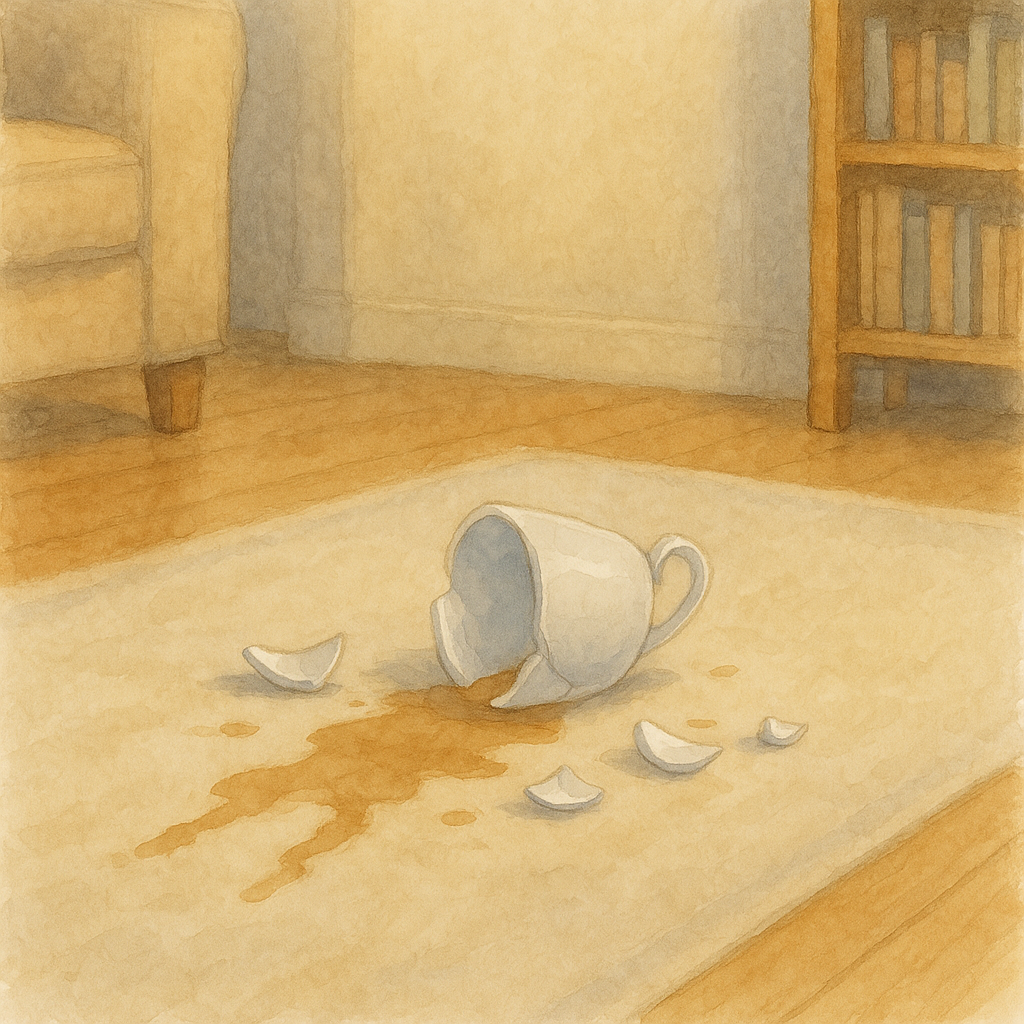
Porcelain Tremors
In the hush of the afternoon, a quiet shatters;
white fragments bloom on the floor like brittle petals.
The spill curls outward, a stain in slow bloom,
and the room holds its breath,
as if waiting for the next thing to break.
Fear moves like that;
not as a roar, but a seep.
It slides under doors,
gathers in the corners of the mind,
whispering of what cannot be mended.
Yet even here, amid the ruin,
light leans in across the rug.
Its warmth rests on every shard,
as if to say:
Nothing is so broken it cannot hold the sun.
Dr. Benjamin Tranquil
When Fear Walks in
There is a hush that comes over a room when fear walks in. Hearts quicken. Shoulders rise. Thoughts scatter like startled birds. Many of us know that hush well right now. Headlines tighten the chest. Bills whisper at night. Relationships feel like thin ice in late spring. You are not alone. Scripture never pretends the world is gentle, yet it never leaves us without a sturdy handhold either.
“When I am afraid, I put my trust in you.” Psalm 56 says it plainly. Not if I am afraid. When. Fear is not failure. It is a signal. It is the body’s honest messenger that something feels threatened. The question is not whether fear speaks. The question is whether we let it set the course of our life.
A small story about a larger God
A woman I will call Mara came to me during a winter of losses. Work felt unstable. Her son was struggling. Her sleep was thin. She told me she was living three minutes at a time. When she tried to plan her week, a storm of what-ifs swarmed her mind. What if I miss something important. What if I fail my child. What if the worst happens.
We did not try to shout her fear into silence. We honored it as information, but not as lord. I invited her to do three simple things each day for two weeks.
First, name the fear in one sentence. Not a paragraph. Not a speech. One clean sentence.
Second, test the fear with truth. Not platitudes, but words anchored in God’s character. “Fear, you say I am alone. The truth is that God said, ‘I am with you.’” She began reading Isaiah 41:10 out loud in the kitchen while her tea steeped. “Fear not, for I am with you. Be not dismayed, for I am your God. I will strengthen you, I will help you. I will uphold you with my righteous right hand.”
Third, take one faithful action that fits the truth. If the fear said, “You will freeze and do nothing,” the action might be a single phone call, a five-minute budget review, or a kind text to her son’s teacher. Small obedience. Immediate traction.
Two weeks passed. The circumstances had not fully changed, yet Mara’s posture had. She was still honest about the tremor in her chest, but she was no longer letting the tremor tell the story. She told me, “I learned the difference between danger and discomfort. I stopped treating every worry like a prophecy.” The storm had not disappeared, but it no longer held the map.
Fear, attention, and the stories we rehearse
Fear loves a stage. It grows where attention dwells. Many of us rehearse worst-case scenes without realizing it. We play them frame by frame until the imagined becomes heavier than the real. Scripture meets this habit with something remarkably practical. It invites us to rehearse a different narrative.
“Do not be anxious about anything” does not float in a vacuum. Paul immediately gives a practice. Present the specific request to God with thanksgiving. The mind does not thrive in a vacuum. Give it an object. Name the request. Name the gratitude. This is not denial. It is training your attention to dwell where help actually lives.
There is a quiet psychology to this. Fear condenses time and shrinks our world to the worst possibility. Gratitude widens time and returns us to the ground under our feet. Specific prayer orders our inner life. It is hard to spiral while speaking a concrete request to the One who has already pledged Himself to you.
one.
The voice that calms water
Peter stepped out of the boat while the wind was still loud. He did not wait for calm seas. He moved toward Jesus inside the storm. When he saw the wind, he began to sink. He cried, “Lord, save me.” Immediately Jesus reached out His hand. The water did not earn Peter’s attention by accident. It is loud. Fear is loud. Yet the voice of Christ is near enough to grasp the wrist of a sinking man.
Fear often says, “You must control everything or disaster will come.” The hand of Christ says, “You are held by more than your grip.” There is a difference between responsibility and control. Responsibility is faithful, specific action. Control is the illusion that you can guarantee an outcome by worrying hard enough. Worry feels like work, but it never builds a single plank on the boat.
Here is a small liturgy for those moments when the waves are tall. Breathe in and say, “Lord Jesus.” Breathe out and say, “Hold me.” Do it five times. Then ask, “What is the next faithful step, not the next fifteen.” Take that step. Leave the rest in His hands. That is not passivity. That is trust trained into action.
Sorting fear into three boxes
When fear surges, everything blurs. It helps to sort what you face into three simple boxes.
- Things I can act on today.
- Things I can prepare for but not control.
- Things I must entrust to God.
Write one item in each box. Then do one small action from box one before lunch. Make one preparation from box two before dinner. Speak one prayer from box three before bed. You are realigning your life with reality. You act where action is given. You plan where planning is wise. You release where release is holy.
Over time you will notice something gentle. Fear still knocks, but it no longer moves in. Your soul gains calluses in the best sense, the way a musician’s fingers toughen and the strings sing clearer.
The truth about courage
Courage is not the absence of fear. It is rightly ordered fear. Scripture teaches us to fear God first, which means to revere and trust Him above all. Every lesser fear finds its place when the greatest allegiance is settled. “For God gave us a spirit not of fear but of power and love and self-control.” Power that acts. Love that seeks the good. Self-control that keeps the mind from running headlong into the thickets.
Notice the shape: power without love becomes harsh. Love without self-control becomes sentiment. Self-control without power becomes paralysis. In Christ, all three are given as gifts. Receive them. Practice them. Expect them to grow slowly the way oaks grow, ring by ring.
A word for parents, students, caregivers, and those who feel alone at night
Parents, your child does not need a perfect home. They need a parent who tells the truth and takes the next faithful step. Name the fear. Anchor it in God’s promise. Do the next small good.
Students, your future is not decided by a single exam. Learn the craft of attention. Study with prayer. Rest with honor. Ask for help. You are allowed to be unfinished while God is still working in you.
Caregivers, you carry more than most can see. Strength is not stoicism. Schedule your own replenishment as if it were medicine, because it is. Ask one person to pray with you each week for ten minutes. Say the need plainly. Receive grace without apology.
To the one who feels alone in the hours after midnight, remember Elijah beneath the broom tree. He was exhausted and wanted it all to end. God sent sleep, then food, then a gentle voice. Sometimes the holiest thing you can do is drink water, eat a small meal, and close your eyes for twenty minutes. God meets bodies as well as souls. He made both.
Closing prayer
Lord of the storm and the shoreline, we bring you our honest fear. Teach us to listen without bowing down. Teach us to act without pretending to be in charge. Stretch out your hand as you did for Peter. Set our feet where they should go. Give us power to take the next small faithful step, love to seek another’s good, and self-control to quiet the noisy rooms of our mind. We trust that you are with us, you will help us, and you will uphold us. Amen.
Further reading by faithful, reputable voices
- Anxious for Nothing by Max Lucado. A practical, Scripture-rich guide to redirecting the heart toward peace in Christ through prayer, gratitude, and wise focus.
- Trusting God by Jerry Bridges. A clear, time-tested exploration of God’s sovereignty and goodness that equips readers to face uncertainty with steady confidence.
~Dr. Benjamin Tranquil